
Reducing regional inequalities is one of the most overused phrases in development policy. Yet in places like this, more direct and more human language is needed if initiatives aimed at helping the most disadvantaged are to achieve real impact.
The Gönc district in Borsod-Abaúj-Zemplén County has for years been one of Hungary’s most deprived regions. In many of its settlements, unemployment, limited access to services, and deep poverty are part of everyday life, while young people’s opportunities are often constrained from the very start. Nearly one-third of the population lives in villages where access to public services is limited, and the proportion of disadvantaged students is far above the national average.
It was in this environment that the Hungarian Interchurch Aid launched its model project, Infinite Opportunity, supported by the European Union under the Széchenyi 2020 programme, with the aim of helping Hungary’s most disadvantaged regions catch up.
Research and practical experience alike show that poverty on this scale cannot be addressed by focusing on a single issue. These communities face layers of interconnected challenges that cannot be solved through infrastructure development alone or through interventions targeting just one area. The difficulties are complex because they affect housing, education, employment, health, and mental well-being all at once. That is why a comprehensive approach is essential—and that is exactly what this project set out to provide.
The programme was built on a thorough assessment of local needs. Experts carried out research, interviews, and data collection, and this diagnosis became the basis for a targeted development plan. Local cooperation also played a central role. Municipal leaders, civil society organisations, and church institutions worked together to find solutions, ensuring that the widest possible range of expertise and experience could contribute to the project’s success. This collaboration helped different professional methods and perspectives reinforce one another, making it possible to respond to a broad range of local problems. District development forums and service-provider roundtables also created opportunities for stakeholders to think together about the future of the region.
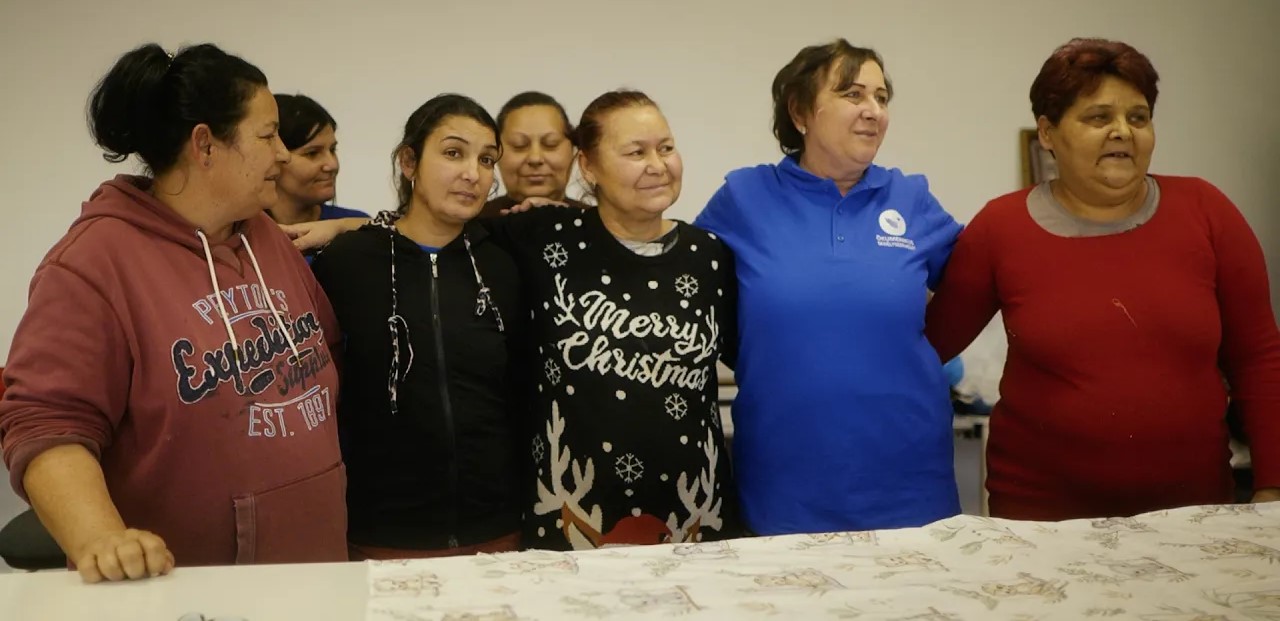
One of the most important methodological elements of this model of social inclusion was continuous presence. In Vizsoly and Boldogkőújfalu—like in many of Hungary’s most disadvantaged settlements—so-called Presence Points were established. Based on the initial assessment, the project developed the most urgent interventions in the form of programmes and services. At these Presence Points, support professionals have since been available every day in a reliable and predictable way. Local residents can turn to them for help, while they also organise ongoing activities and community programmes that engage those in need. In this way, the Presence Points have become central spaces for community life, while also offering room for individual support. Poverty may follow familiar social patterns, but every person’s story is different. For one family, the greatest need may be child development support; for another, it may be building the skills needed for employment; elsewhere, the priority may be managing a crisis.
The project sought to offer support to every age group. Child development sessions, school-based prevention programmes, community experience days, and labour-market development initiatives all formed part of the response. Support always served a dual purpose here as well: alongside immediate assistance, the interventions were also designed to help individuals and communities build the capacity to move forward over the longer term by relying on their own resources.
The results of programmes like this are often difficult to measure in purely numerical terms. Every individual story matters in itself, but perhaps what matters most is whether community members come to see the path they have stepped onto as useful, worth following, and beneficial to their future—something that gives them hope and encourages them to stay on that path even after the project has ended. That is exactly what our short film about the project reveals: the support services work, and the new opportunities that have opened up provide real motivation in everyday life.
In any community, patterns change slowly, and trust takes time to build. Every small success matters. But if even one person can be helped to step out of the trap of poverty, then a door has been opened toward a fairer future. And the one who steps through it may one day return, take others by the hand, and help them rise even higher together.
The development was implemented from EU funding in the project EFOP-1.5.1-17-2017-00003 under the Human Resource Development Operational Programme.
Find out more about the project in the Project Finder: