

Today, it feels only natural that a dual two-lane bypass runs along the western edge of Székesfehérvár, carrying the traffic of Main Road No. 8 around the city. Those who use it every day may hardly remember that this stretch of road was completed only a few years ago.
He looked at the worn grass and the dusty wheel tracks beside it, searching for a stable spot to set up the leveling tripod. To his left flowed the Gaja Stream; to his right, high-voltage power lines. Ploughed fields stretched out in every direction. Behind him stood the bridge of Route 7—surprisingly close—yet the landscape here felt relatively quiet. In the distance, rows of trees; some of them would certainly disappear. He would need to cross to the embankment on the opposite bank as well—perhaps the simplest way would be on foot, over that bridge, even if the equipment was heavy.
He peered into the instrument. He focused roughly on the first transmission tower, aligning the leveling staff. He read off the numbers, but his gaze lingered in the optics.
He saw a crossing—a wide road with guardrails. Cars, trucks, buses speeding along. Faster access, less congestion, fewer accidents, safer arrivals. Music playing freely, without stress, without potholes, without intersections. Open movement as part of a vast international road network—something to take pride in, something optimistic. But the noise would be greater, that much was certain. Something for something. Time to move to the other side.
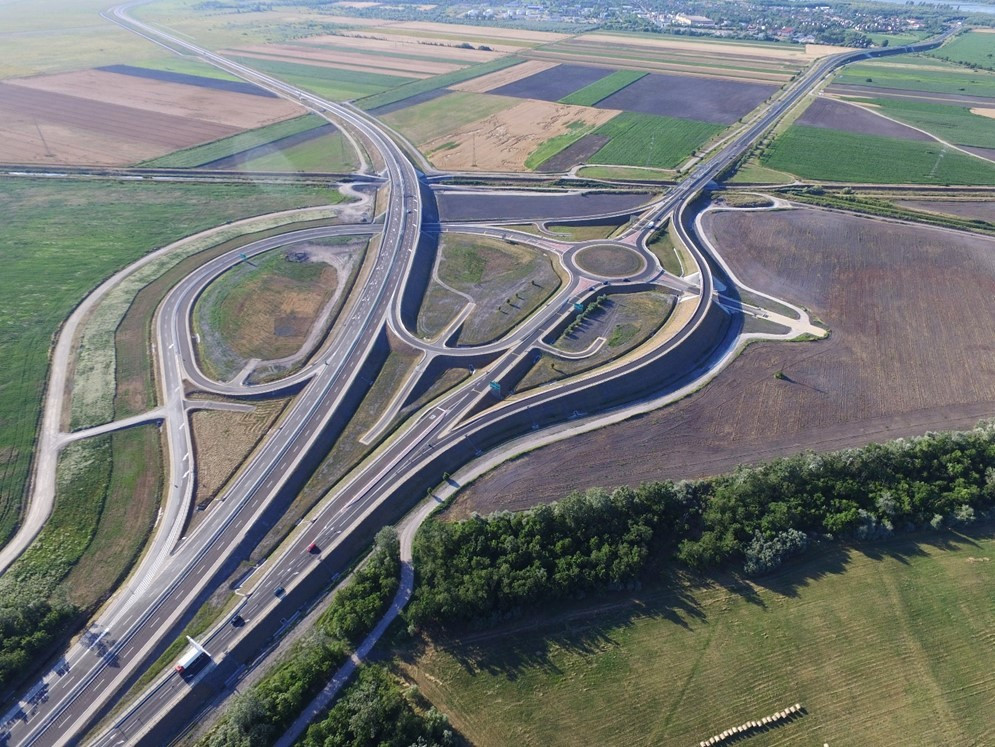
Supported by the European Union, the project set out to complete a missing link in the TEN-T road network here on the western boundary of Székesfehérvár, strengthening Hungary’s transport infrastructure and eliminating a local bottleneck.
The new section was built along a new alignment, with four traffic lanes, a physical central barrier, and a design speed of 110 km/h. The investment included two grade-separated interchanges and eight road bridges. The surrounding road network was also upgraded: two intersecting dirt roads and nearly twenty parallel service roads were constructed, totaling approximately 11,250 meters in length. Significant utility relocations were carried out as well, including telecommunications lines, low- and medium-voltage power lines, high-voltage transmission lines, and various pipelines.
As a result of the development, the Feketehegy district of Székesfehérvár was relieved of the heavy through traffic of Main Road No. 8. Travel times to the M7 motorway from nearby settlements were reduced, and the bypass was seamlessly integrated into further road improvements between Székesfehérvár and Veszprém.
Today, this stretch of road is a natural part of everyday travel. It is hard to recall the time when it did not yet exist—when the first survey stakes were set out there on the worn grass, beside the dusty tracks, on the banks of the Gaja Stream.
The development was implemented from EU funding in the project IKOP-1.1.0-15-2016-00007 under the Integrated Transport Development Operational Programme.
Find out more about the project in the Project Finder:Details